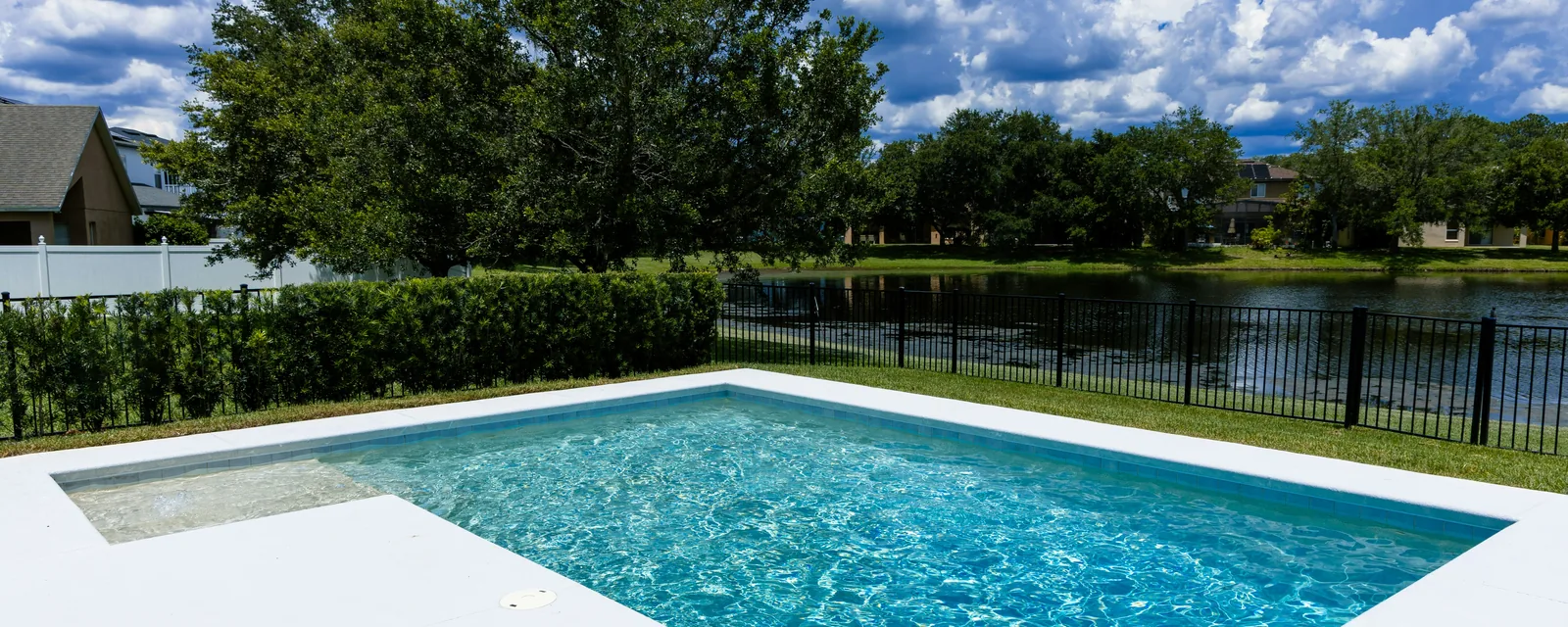
Home › Inground Pool Cost
$44,500 – $87,500 National average: $65,909 (HomeAdvisor, June 2026). A small vinyl pool with a basic install can land under $30,000. A large custom concrete pool with decking, a heater, and a cover clears $120,000 without trying.
Those are real numbers, and the range is wide for a reason. Size, material, your state, and what the quote actually includes each move the price by tens of thousands. This page breaks down all four, shows you where the money goes line by line, and covers the parts of the quote most builders leave out of the first conversation.
Inground pool cost at a glance
| Tier | Price range | What it buys |
|---|---|---|
| Budget | $25,000–$45,000 | Smaller vinyl-liner pool, basic install, minimal decking |
| Typical | $45,000–$90,000 | Mid-size vinyl, fiberglass, or entry concrete with standard equipment |
| High-end | $90,000–$135,000 | Large fiberglass or concrete, real decking, heater, automatic cover |
| Extreme | $135,000+ | Custom concrete, infinity edge, spa, enclosure |
Sources: HomeAdvisor 2026 ($14,000–$135,000 full spectrum), HomeGuide 2026 ($25,000–$100,000), Fixr 2024.
Inground pool cost by size
Two honest columns, because published size prices mean different things. HomeAdvisor's figures price the pool and basic installation. This Old House prices the finished project: pool plus decking, fencing, and the rest. Both are correct. They're just measuring different things, and most cost articles never say which one they're quoting.
| Size | Sq ft | Pool + basic install | Finished project |
|---|---|---|---|
| 10x20 | 200 | $10,000–$25,000 | $26,000–$70,000 |
| 12x24 | 288 | ~$25,200 | $38,000–$100,000 |
| 14x28 | 392 | ~$34,000 | — |
| 16x32 | 512 | ~$44,800 | $67,000–$180,000 |
| 18x36 | 648 | ~$56,700 | — |
| 20x40 | 800 | ~$70,000 | — |
Basic-install column: HomeAdvisor, 2026. Finished-project column: This Old House, 2025.
Per square foot, published figures run from $50–$125 (Forbes, 2025 data) to $80–$250 (HomeGuide, 2026) to $180–$350 (This Old House, 2025). Same split: the low ranges count the pool, the high ranges count the backyard. When a builder quotes you per square foot, ask which one he means.
Pricing a 12x24 specifically? → The most-quoted starter size, broken down by material — plus 16x32 and 20x40.Inground pool cost by type
| Material | Installed cost | Build time | 10-year upkeep |
|---|---|---|---|
| Vinyl liner | $40,000–$75,000 | 4–8 weeks | $11,000–$17,000 |
| Fiberglass | $55,000–$100,000 | 3–5 weeks | $5,000–$15,000 |
| Concrete/gunite | $65,000–$120,000 | 2–6 months | $27,000–$40,000 |
Vinyl liner: cheapest to buy
$40,000–$75,000 installed. The structure is a frame with a fitted liner, which is why the entry price is the lowest of the three. The catch is the liner itself: it needs replacing every 5 to 9 years at $4,000–$8,000 per swap (River Pools, 2024). Budget for that before calling vinyl the cheap option.
Fiberglass: cheapest to own
$55,000–$100,000 installed for most builds. Manufacturers selling turn-key packages run higher: River Pools quotes $85,000–$200,000 for a complete fiberglass project, decking and equipment included. The shell arrives in one piece, drops into the hole, and the smooth gelcoat surface resists algae. That's why its 10-year upkeep is the lowest on the table.
Concrete/gunite: most flexible, most expensive twice
$65,000–$120,000 installed, and custom work runs well past that. Concrete is the only choice for a fully custom shape, a vanishing edge, or unusual depth. It is also the most expensive pool to own: acid washing every 3 to 6 years, resurfacing at $8,000–$10,000 every 10 to 15 years (Bankrate, 2025), and the heaviest chemical use of the three.
The 10-year cost nobody quotes
The sticker price picks the wrong winner. Over ten years of ownership, This Old House puts upkeep at $5,000–$15,000 for fiberglass, $11,000–$17,000 for vinyl, and $27,000–$40,000 for concrete. River Pools' ownership data says the same thing in the same order.
Run the math on a $60,000 fiberglass pool versus a $50,000 vinyl pool. After one liner replacement and ten years of higher chemical use, the vinyl pool's head start is mostly gone. After two liner swaps it's a wash or worse. Cheapest to buy and cheapest to own are different questions. Decide which one you're answering before you sign.
Where the money actually goes
Here's the number that explains everything else on this page. A complete DIY inground pool kit — the actual pool — costs $7,600 to $26,000 (Royal Swimming Pools, 2025). Professionally installed, that same class of pool costs $28,000 to $55,000 and up. The pool is a third of the project. The rest is what it takes to put a pool in the ground:
| Line item | Typical cost or share |
|---|---|
| Excavation and dirt work | $1,000–$5,000 |
| Shell/structure | 25–35% of project |
| Plumbing and electrical | 10–15% of project |
| Equipment: pump, filter | 15–20% of project |
| Labor across all phases | $8,000–$30,000 |
| Permits | $100–$2,000 |
| Decking/patio | $3,000–$20,000 |
| Fencing (required by code nearly everywhere) | $1,500–$10,000 |
| Landscaping repair | $700–$3,300 |
River Pools, a builder, states it plainly: plan on $25,000–$50,000 beyond the pool itself for electrical, patio, fencing, and accessories. When a quote looks $20,000 lighter than the others, this table is usually where the difference is hiding.
Add-ons and extras
| Add-on | Cost | Worth knowing |
|---|---|---|
| Gas heater | $1,500–$6,000 | $250–$400/month to run |
| Heat pump | $2,000–$6,500 | $100–$150/month; slower but far cheaper per degree |
| Automatic safety cover | $6,000–$22,000 | ~$10,000 average; doubles as the safety barrier in some codes |
| Saltwater system | $500–$3,300 | Still a chlorine pool; the cell makes the chlorine |
| Lighting | ~$200 per light | $450–$1,200 typical total. LED only |
| Attached spa | $5,000–$8,000 | Concrete builds only, priced with the shell |
| Screen enclosure | $4,300–$7,850 | Per 1,000 sq ft. Standard in Florida, rare elsewhere |
| Water to fill it | $60–$2,400 | City water at the low end; trucked at the high end |
| Diving board / slide / waterfall | $300–$20,000 | Boards raise insurance questions — ask your agent first |
Sources: HomeAdvisor 2026, HomeGuide 2026, Fixr 2024, This Old House 2025.
What it costs to own
The purchase is not the whole bill. Plan on $3,000–$6,000 a year, all-in (HomeAdvisor 2026; Bankrate 2025 agrees):
- Routine maintenance: $90–$270 a month doing most of it yourself; a weekly service runs $20–$50 for basic chemical visits, $80–$150 for full service
- Electricity: $65–$100 a month while the pool is running
- Opening and closing: $300–$650 a year in four-season states
- Insurance: about $20–$25 a month added to homeowner's premiums, and property taxes can rise 5–10% after the assessor notices the pool
Inground pool cost by state and region
Location moves the price 20–40%. Labor is the reason: pool crews in the Southeast bill around $65 an hour against $115 in the Northeast, and permitting is heavier in high-regulation states. Reported ranges from recent project data: California $75,000–$150,000. New Jersey and the Northeast $45,000–$85,000 plus stricter permitting. Florida $35,000–$75,000, the best value in the country. Texas moderate. In Louisiana, builder-published pricing runs $35,000–$55,000 for vinyl, roughly $50,000–$65,000 for fiberglass, and from about $70,000 for gunite.
The materials cost roughly the same everywhere. What you're paying for by region is labor, regulation, and how busy the local builders are.
See what a pool costs in Shreveport-Bossier → Real local builder pricing, permit fees in dollars, and a full all-in worked example.What pool builders won't tell you
Five rules for reading a pool quote. Each one exists because the industry's pricing habits reward the builder, not you.
- A "starting at" price is the pool, not the project
The $45,000 banner price is the shell and basic install. Decking, fencing, electrical service, and water are "site-dependent," which means extra. Ask every builder the same question: what is the all-in number for a swim-ready backyard?
- The dig is where quotes turn into change orders
Rock, groundwater, and buried debris are billed as surprises. They are only surprises to you; the builder has hit all three before. Ask what the contract says happens per foot of rock and who pays for dewatering. Get it in writing before the excavator shows up.
- Two bids $30,000 apart can describe the same pool
One includes decking, equipment upgrades, and startup chemicals. One doesn't. Never compare bottom lines. Make every bidder fill in the same line items, then compare rows.
- Allowances are placeholders, not prices
A $3,000 "decking allowance" buys a fraction of the decking you're picturing. Every allowance in the contract is a number that will grow. Ask what the allowance actually covers at today's material prices.
- The deposit schedule tells you who carries the risk
Money ahead of work is your risk. A schedule tied to completed phases — dig, shell, plumbing, deck — is his. Reasonable builders bill by milestone. Walk away from anyone who wants half up front.
How long an inground pool takes
The permit comes first, and it's the wildcard: 1 to 10 weeks depending on your county (River Pools, 2025). No builder controls that clock. Once the permit clears, the build runs in phases:
| Phase | How long |
|---|---|
| Excavation | The dig itself takes 4–8 hours. The phase can stretch to weeks if crews hit rock, groundwater, or bad weather |
| Fiberglass: set shell, backfill, form | 2–3 days |
| Concrete pools: gunite cure | 30+ days before work continues |
| Patio and decking pour | 2–3 days; longer for stamped concrete |
| Cleanup, grading, fill, startup | 2–4 days |
Totals by material: fiberglass 3–5 weeks (the shell arrives finished and drops into the hole in a day or two), vinyl 4–8 weeks, concrete 8–12 weeks for a straightforward build and 3–6 months for custom work, because gunite is built in place and spends a month curing before tile and plaster can start.
One scheduling fact worth money: builders book spring solid. Sign in fall or winter and you get both a discount and a start date. Sign in April and you get a place in line.
Paying for it
A $70,000 pool at 10% APR on a 10-year loan is about $925 a month. That single line reframes the whole purchase, so run it on your own numbers before touring showrooms. Pool loans in 2026 run roughly 8–20% APR depending on credit (NerdWallet, HFS Financial).
Four ways to fund it (Bankrate, 2025): a home equity loan (lowest rates, your house is collateral), a HELOC (flexible draw, variable rate), an unsecured personal loan (fixed rate, faster, 2–10 year terms), and dealer financing (convenient, usually the most expensive of the four). If the monthly payment only works at the teaser rate, it doesn't work.
How to spend less
- Go rectangular and go smaller. Custom shapes and every extra foot of perimeter cost money at dig, shell, decking, and cover time. A 14x28 rectangle swims almost like a 16x32 and prices thousands lower.
- Run the lifetime math before taking the cheapest bid. Vinyl wins the sticker war and loses the decade war.
- Sign in the off-season. Builders fill winter schedules with discounts they won't offer in April.
- Consider a semi-inground pool. $4,000–$25,000 installed (Angi, 2026). The honest middle option nobody markets.
- An above-ground pool costs a tenth as much. $1,600–$7,500 installed on average (HomeGuide, 2026). If the goal is kids splashing in July, that solves it.
- Be honest about DIY. The kit is $7,600–$26,000, but excavation, concrete, plumbing, and electrical are not beginner work, and a failed dig costs more than the installer would have. DIY the decking or landscaping instead; leave the hole to professionals.
Frequently asked questions
How much does a 12x24 inground pool cost?
$25,000 for a basic vinyl install to $100,000 for a turn-key concrete build. Most land between $38,000 and $65,000. Full breakdown: 12x24 inground pool cost.
How much value does an inground pool add to a house?
About 5–7% on average (HomeGuide, Angi, 2026), with a wide spread: near zero in cold climates where pools are rare, 10% or more in Sun Belt neighborhoods where buyers expect one. The National Association of Realtors puts the average payback at about 56% of what you spent. Build a pool to swim in it, not as an investment.
What is the smallest inground pool?
Plunge pools and spools run around 10x10. Even at that size, expect $18,000–$35,000 installed (This Old House, 2025), because excavation, plumbing, and permits don't shrink with the pool.
Should I get an above-ground or inground pool?
Above-ground: $1,600–$7,500, up in a week, and it can move with you or come down. Inground: $45,000–$90,000, permanent, and the only version that adds real home value. It's a budget question first and a permanence question second.
How much space do you need for an inground pool?
Plan on roughly 1,200 square feet of usable yard for a 12x24 pool, which leaves about 10 feet on every side for patio and code setbacks (River Pools, 2024). Most municipalities require the water's edge to sit 5–10 feet off property lines, and the numbers vary town by town, so check local code and easements before falling for a design. A useful ceiling: the pool shouldn't take up more than a quarter to a third of the backyard.
How long does an inground pool last?
Concrete lasts 50–75 years with upkeep. Fiberglass runs 30 or more with no resurfacing (Angi, 2026). Vinyl is two answers: the liner needs replacing every 7–10 years no matter what, and sources disagree on the structure itself — Angi says 8–15 years, pool-industry sources say 20–30 with good water chemistry. Whatever the material, the pump, filter, and heater are 10-to-15-year equipment, not lifetime equipment.
How much does it cost to repair a swimming pool?
Most repairs land between $50 and $1,700 (HomeGuide, 2026). The common big-ticket items: pump replacement typically runs $700–$4,000 with most paying around $1,300, filter replacement $250–$2,000 installed, and leaks cost $100–$500 to find plus $500–$1,500 to fix (Angi and HomeGuide, 2026).
Sources
- HomeAdvisor, Inground Pool Cost, updated June 2026
- This Old House, Inground Pool Cost, June 2025
- Bankrate, Swimming Pool Financing & Costs, April 2025
- HomeGuide and Angi 2026 cost data; Fixr, January 2024; Forbes Home, February 2025
- River Pools & Spas cost guide (December 2025) and ownership-cost data
- Royal Swimming Pools DIY kit pricing, 2025
- NerdWallet and HFS Financial 2026 pool loan rates
- National Association of Realtors 2023 Remodeling Impact Report (via HomeGuide)
Where sources disagree — per-square-foot pricing, vinyl structure lifespan — both figures are shown rather than averaged. Angi and HomeAdvisor publish identical data under one parent company and are treated as a single source.